The Second DR2 Conference was held at the University of Turin on February 13-14. We would like to thank all the speakers and the participants for the interesting and intense debate.
* * *
The conference was opened by Franco Moretti’s self-critical reflections on data visualisation in cultural history. To see and listen to the video of Moretti’s opening lecture (in Italian, with the title “La visualizzazione dei dati nella storia culturale: riflessioni autocritiche”), please click on the picture below.
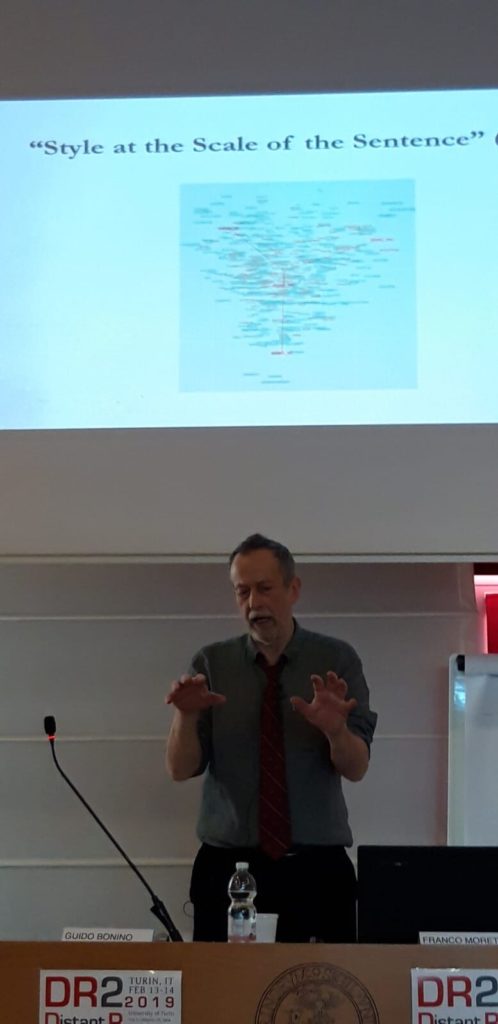 The conference was divided into two main sessions. The first session was devoted to the issue of style in philosophy. As Guido Bonino and Paolo Tripodi (University of Turin) stated in the introductory remarks, the aim of the session was that of understanding how to investigate philosophical style from a historical point of view by employing distant reading techniques and quantitive methods.
A preliminary task, that of clarifying the very concept of philosophical style, was tackled by Nakul Krishna (University of Cambridge).
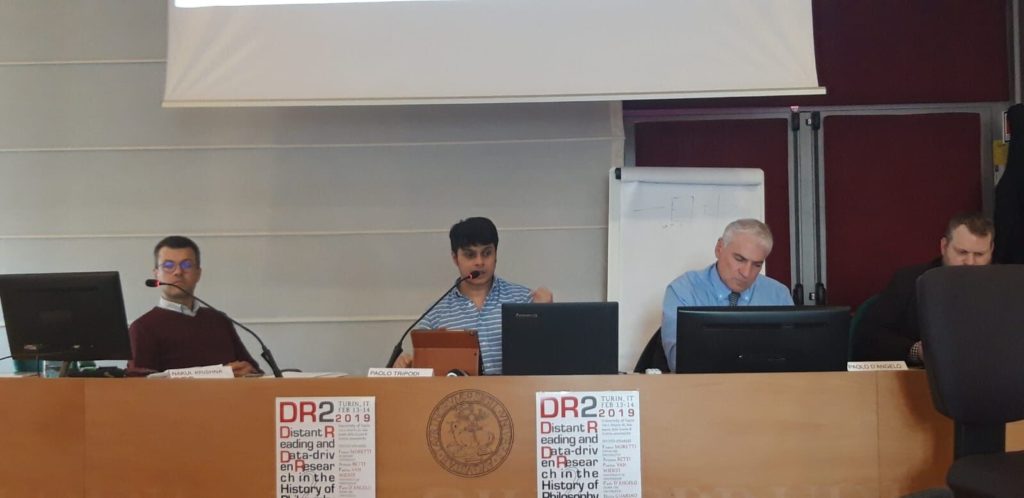
Glenn Roe (University of Paris, Sorbonne) presented a survey on stylometric studies in the digital humanities, focusing on Voltaire as an example.

Paolo D’Angelo (University of Rome III) closed the first session by reflecting upon the the relationship between style and literary genre in philosophy.

* * *
The second session was devoted to the issue of corpora building.
In his talk Enrico Pasini (University of Turin) offered some remarks on the methodological and epistemological challenges posed by corpus-based research in the history of ideas.
Starting from the consideration of several case-studies taken from Arianna Betti’s research group in Amsterdam, Arianna Betti and Pauline van Wierst (University of Amsterdam) reflected on the practical and methodological difficulties one may encounter in building corpora, with a special focus on the problems of the objectivity and quality of corpora.
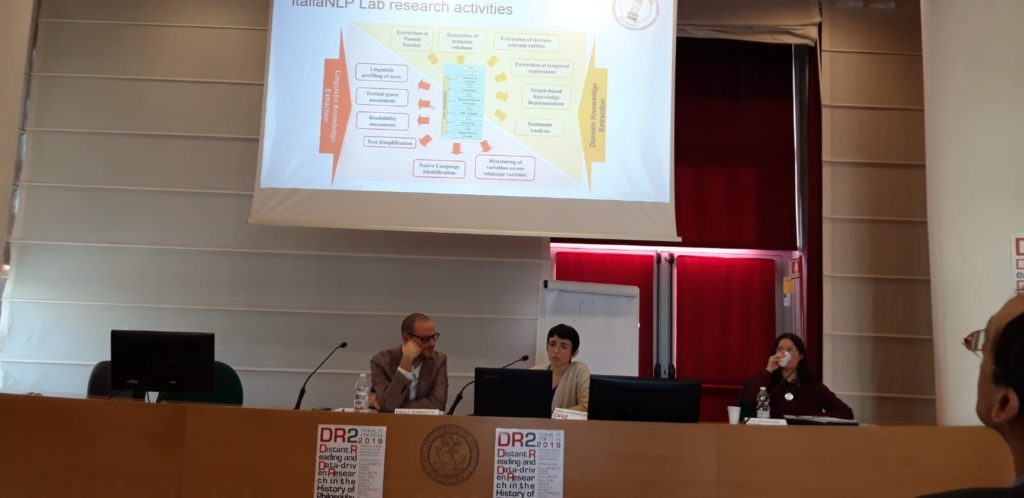
The second session was closed by Giulia Venturi (CNR, Pisa), who brought to the conference the point of view of computational linguistics by giving a talk on Natural Language Processing methods and instruments for the extraction of information from domain corpora.
The debate was very fruitful, also thanks to the session discussant, Julie Giovacchini (CNRS Paris).
 The concluding lecture, given by Nicola Guarino (CNR, Trento) and introduced by Daniele Radicioni (University of Turin), was based on the idea that applied ontology could provide distant reading and data-driven research in the history of ideas with several useful semantic tools.

* * *
It seems to us that this second DR2 Conference has confirmed that a lively, multidisciplinary and collaborative community is growing up, which includes not only researchers but also students, and this is a good sign for our future work.