
Thanks to the joint efforts of DR2 and the department of Computer Science, a data structure has been set up for a database storing TEPT (Turin Enhanced Philosophy Tree) data.
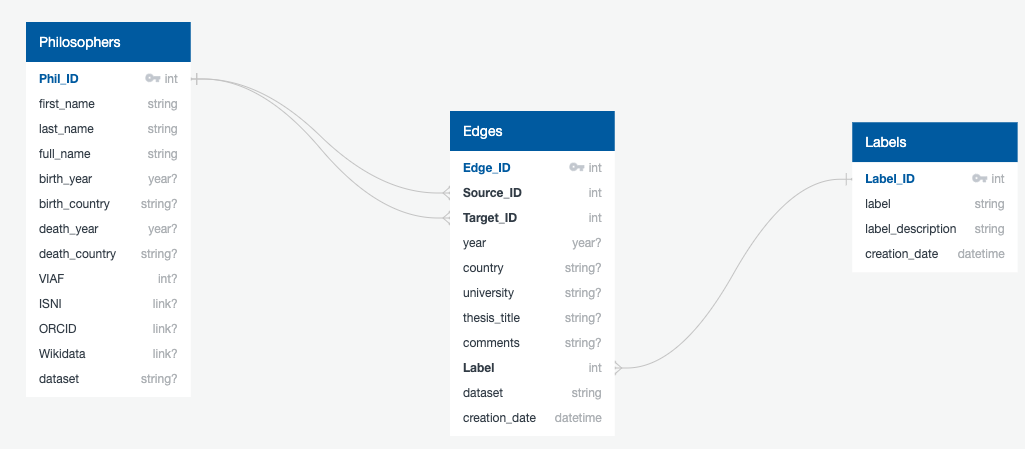
TEPT’s database is a relational database consisting of three tables: the Philosophers table, the Edges table and the Labels table.
This is the schema:
The database is going to be the structure for the managment of data concerning academic descent of philosophers and it will be the backbone of the Tree of Philosophers, a publicly available resource that is going to provide academic genealogical trees of philosophers.
In the “Philosophers” table, each row is indexed by a unique numerical identifier internal to TEPT Database and stores data about one philosopher: name, birth and death dates and places, external personal identifiers for the person at matter. The storage of personal data provides a simple yet effective geographic and chronological individuation of the instances. Years of birth, graduation and death, in particular, allow for the reconciliation of the tree and its soon-to-be graphic representation with a yearly-paced chronological axis, rather than relying solely on the simple succession of generation-based steps. References to digital identifiers (ISNI_ID, ORCID, VIAF_ID, Wikidata) serve two purposes: first, they provide means to reduce the amount of labour required for the entry and correction of data; second, they ensure the interoperability of TEPT database with independent datasets, thus granting some degree of accessibility and versatility as an open research infrastructure to be shared with the research community.
The “Edges” table stores data concerning the descent relations between philosophers, which are the core information that forms links in the tree. Since TEPT is conceived as an incremental project, the design has been oriented towards simplicity and extensibility: the relation table stores ordered pairs of genealogical “masters” and “pupils” (with foreign keys redirecting philosopher IDs). Noticeably, genealogic lines of descent are unpacked in relations linking two people, a “source” (parent) and a “target” (offspring) of the relation of descent. Each asymmetric relation is indexed by a unique internal identifier and feature a year, a country and an academic institution that characterise the specific relation. In those cases in which the relation is connected to the production of a text (e.g. PhD theses for relations of PhD supervisions), the title of the text is stored in a specific field, while an additional field is provided to store comments. Comments also store potential bibliographic references for verifying the descent link, such as snippets of online curricula stating the name of PhD supervisors or archival references. The label assigned to each relation is a foreign key referencing a specific relation type stored in the “Labels” table.
“Labels” table distinguishes between various types of genealogical relationships, such as PhD supervision, graduation thesis supervision, direct tutoring, etc. Each label is assigned a description, which is a textual dossier providing contextual information regarding the historical relation captured by the label and its context of application, provided by the domain experts who identified the specific type of succession relationship.
These structures allow for the formalisation of different historical relations of academic descent, provided that they can be located geographically, chronologically and institutionally. This enables TEPT to sustain the addition of a variety of socio-institutional devices of academic filiation characterizing different historical settings.