
Thanks to the collaboration with Enrico Mensa, Davide Colla and Matteo Delsanto (Department of Computer Science of the University of Turin), TEPT can now rely on a tool for data-entry tasks and for metadata management.
One of the tasks of TEPT is to enhance the accuracy and the usefulness of the data originally available. That is why it was important to develop a system for easy metadata management, which allows us to easily add or edit information concerning each philosopher or relation in the tree. This annotation tool allows us to interact with the database and fill it with additional information on a philosopher or relation. The following kinds of data can be added or edited:
– Name
– Surname
– Birth Year
– Birth Country
– Death Year
– Death Country
– Graduation Year
– Graduation Country
– PhD Year
– PhD Country
– University
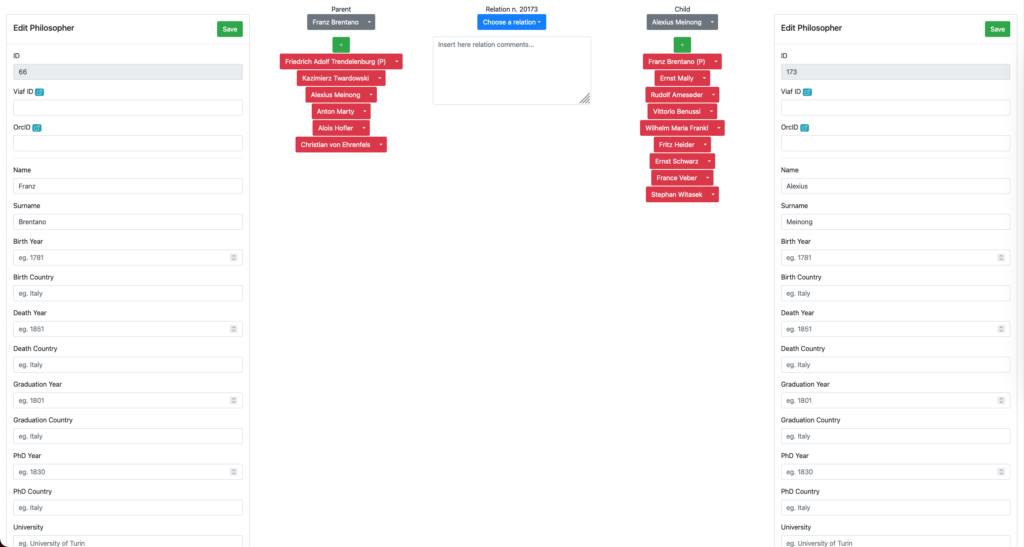
The tool also allows to add comments to each relation in the tree and to assign a label to it, thus defining its nature. This is extremely relevant as genealogical relations in the history of philosophy are historically and geographically varied.
A certain kind of institutional relation that clearly defines a philosopher as the philosophical parent of another in a specific historical context might not have the same relevance in a different context. A clear definition of each type of relation is thus essential in order for the tree to adequately represent distinct real-world institutional relations. The identification of historically accurate descent relations in different academic contexts covered by the tree is still in progress and it will rely on domain-expert advice.
A point of note: the enrichment of the tree by the addition of various kinds of metadata does not serve any genealogical purpose directly. Nonetheless, it provides a firmer grasp on the contexts of the relations of descent. Among other things, contextual information on specific relations makes it easier to detect mistakes in genealogical lines that are integrated in TEPT. In the long run (i.e., in later stages of the project), the addition of both contextual information about relationships and biographical data about people involved will allow for the introduction of filtering functions in the visual representation of the tree. Availability of specific filters and searches will make the tree a more user-friendly and refined tool with a higher value for academic research. In the short run, the enriched tree is simply easier to browse, providing additional pieces of information to the user.