
A short and informal replication of Petrovich and Buonomo 2018

We receive and gladly publish this post from Maximilian Noichl, a MA student at the University of Vienna (check his website and his recent publication).

I recently came across a very interesting study by Eugenio Petrovich and Valerio Buonomo (2018), in which they analyze co-citation networks for the last three decades of analytic philosophy. After a bit of conversation with Eugenio, I thought that I would do a little quasi-replication of their results, to try out some things.

So I downloaded the sample Petrovich and Buonomo used from the Web of Science. It consists of the years 1985-2014 from the following five journals:

  • Philosophical Review
  • Nous
  • Journal of Philosophy
  • Mind
  • Philosophy and Phenomenological Research

The question that Petrovich and Buonomo are interested in is whether analytic philosophy has become more diverse in these thirty years. There are various ways in which one could approach this question. Petrovich and Buonomo go for visual inspection, and I will try to present an approach to that later. But, first and foremost Eugenio and I were talking about formal evaluation of the co-citation graphs. In what follows I took some inspiration from Tang, Cheng, and Chen (2017) who present a recommendable longitudinal study of the digital humanities.

Transitivities

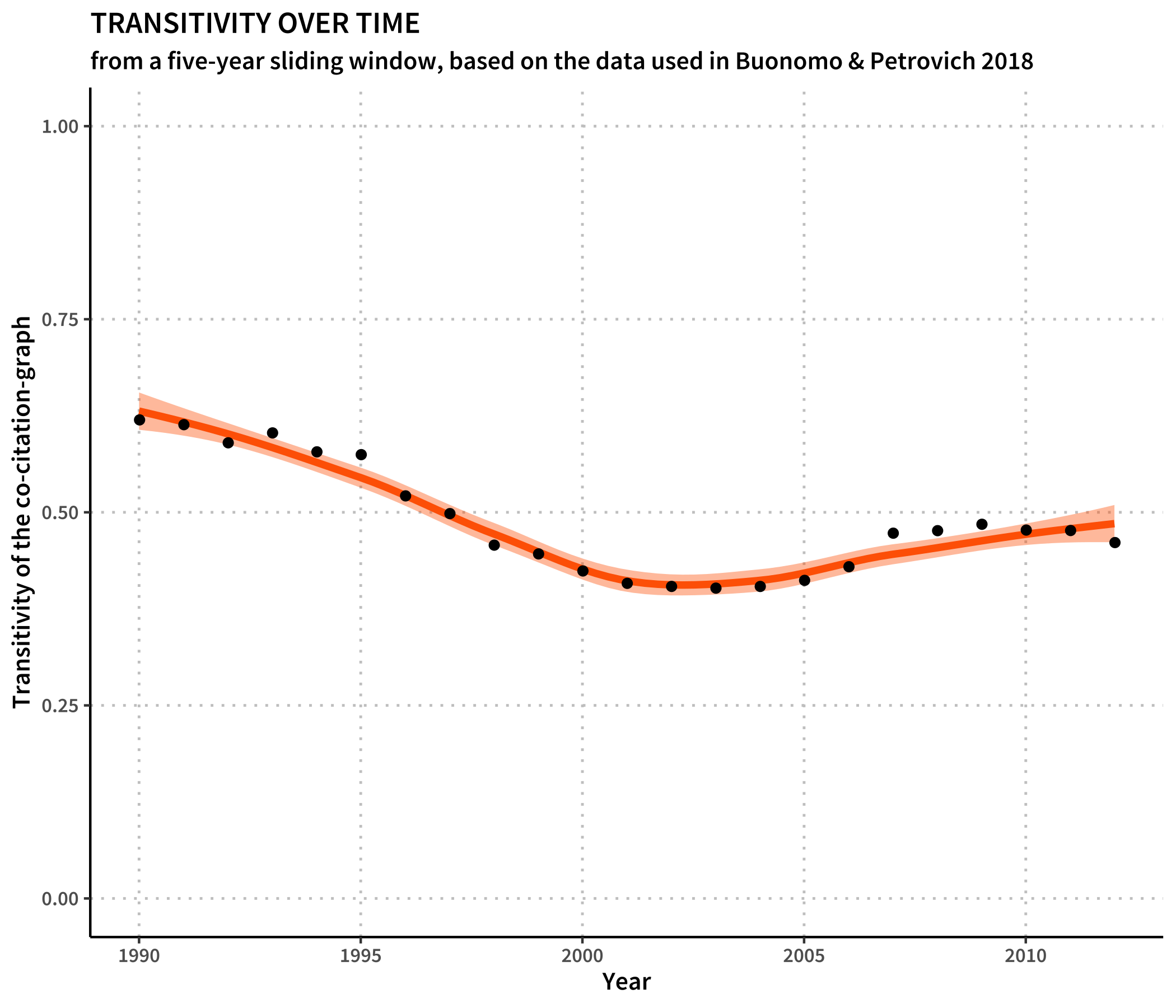
The first thing I did was to try and get the transitivities for the different samples. Transitivity is a very basic measure of how much a graph tends to cluster. It results from three times the number of triangles in the graph (in our case those triangles consist of three sources, of which each combination was co-cited at least once) divided by the number of triplets (any three sources). A fully connected graph would score 1 on this measure, while a completely unconnected graph would result in a 0. For this little exercise I will use a sliding window approach, in which I always consider 5 years together. It results in the following picture:
Transitivities

As we can see, the transitivity gets smaller over time, reaches its lowest point after 2000, and then rises again. I have also looked into the size of the so called giant component of the network, which is the largest connected sub-graph. In all cases it was higher than 93 %, and slowly approaching 98 % over time, which means that nearly all cited sources were connected via co-citation with the others. In other words: There was only one large network of philosophy, not many small unconnected sub-networks. As this was mostly constant, I think we should be able to interpret the falling transitivity as diminished local co-citation: While clusters are at the beginning very tightly knit, they get more diverse over time. We can assume that it is the local connectivity that is getting smaller, as the average minimal distance of nodes in the networks, which describes how far it usually takes to get from one randomly picked node to the next, is pretty much constant over time at 3.16 steps (std: 0.06). This value is pretty small. Short average distances together with high transitivities suggest small-world networks, in which every node can be reached from every other node via only a few steps, because the network consists of tightly clustered subunits, connected via hubs. This is a property we would generally expect from co-citation-networks drawn from one discipline. It seems to me, that we can interpret the slight diminishment of small worldedness as an indication of an increase in the scope of the kind of philosophy that appears in the surveyed journals.

Gini Coefficients

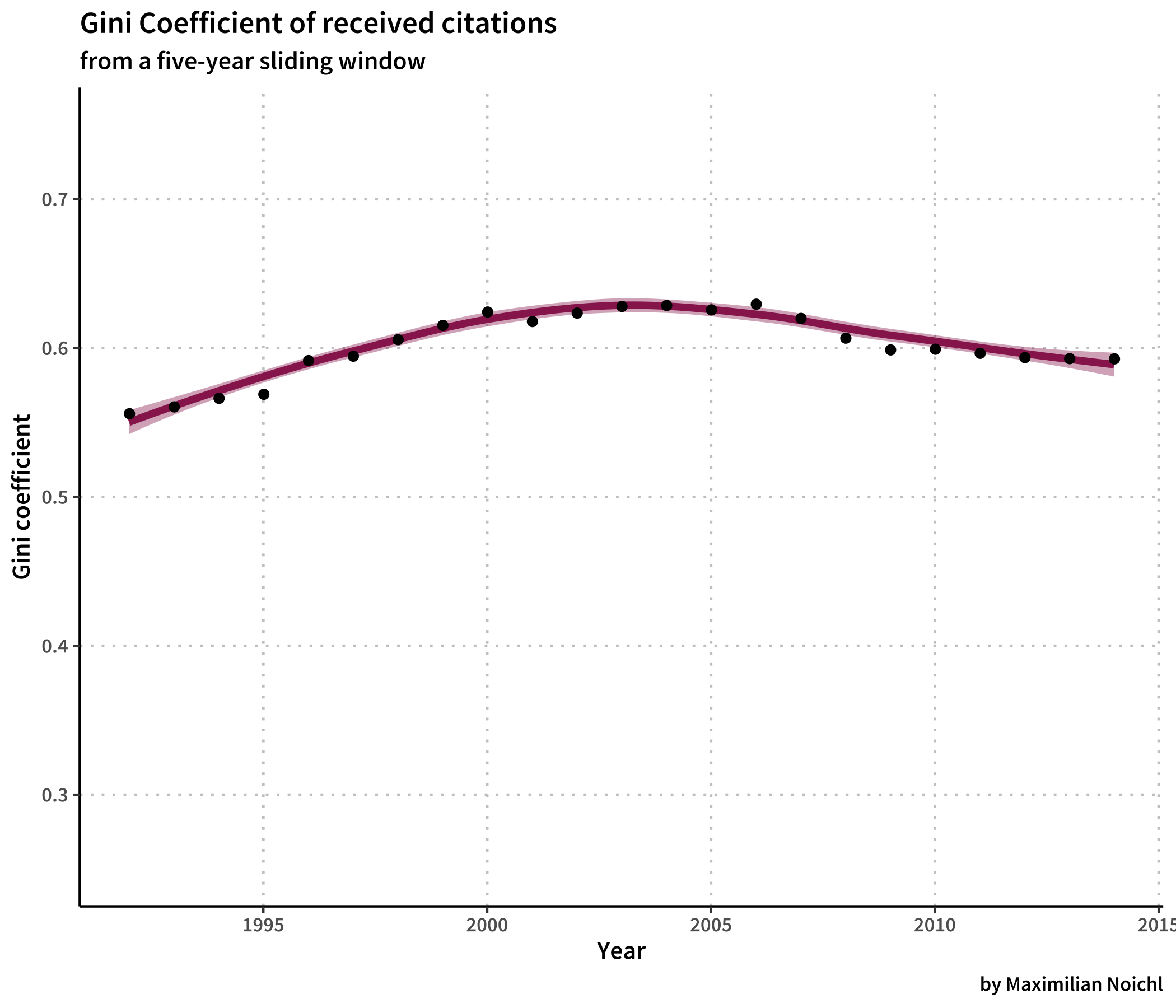
We can do another thing to get an idea about dynamics in the discipline. In some sense, citations can be considered the currency of academia. And like regular currency, some receive more, some less. Indeed, like with regular currency, a select few receive a lot more then everyone else. This suggests that we can use the same tools that are used to quantify financial inequality in societies over time to quantify inequalities in citation-counts over time. Below I have calculated the Gini-coefficients over the same five year windows used above (using a snippet by Olivia Guest). The Gini coefficient quantifies inequality on a scale from zero to one, in which zero means complete equality, while one indicates that everything is owned by only one person.
Ginis

I would tend to interpret high Gini Coefficients as a sign of increased specialization, as they suggest that most articles focus on a similar set of authors. A lower gini-coefficient on the other hand might be indicative of diversification: As the circle of towering figures with very high citation-counts is enlarged, it stands to reason that also the thematic field becomes more varied. By this measure, analytic philosophy, as depicted by our sample, experienced peak specialization in the early 2000s, but has become slightly more diverse since then. This seems to be somewhat add odds with our previous result, so I’m not sure what to make of it. I would like to check this against the actual content of the articles though: Given full-texts, or at least word-vectors, it would be easy to calculate similar measures.

Visualization

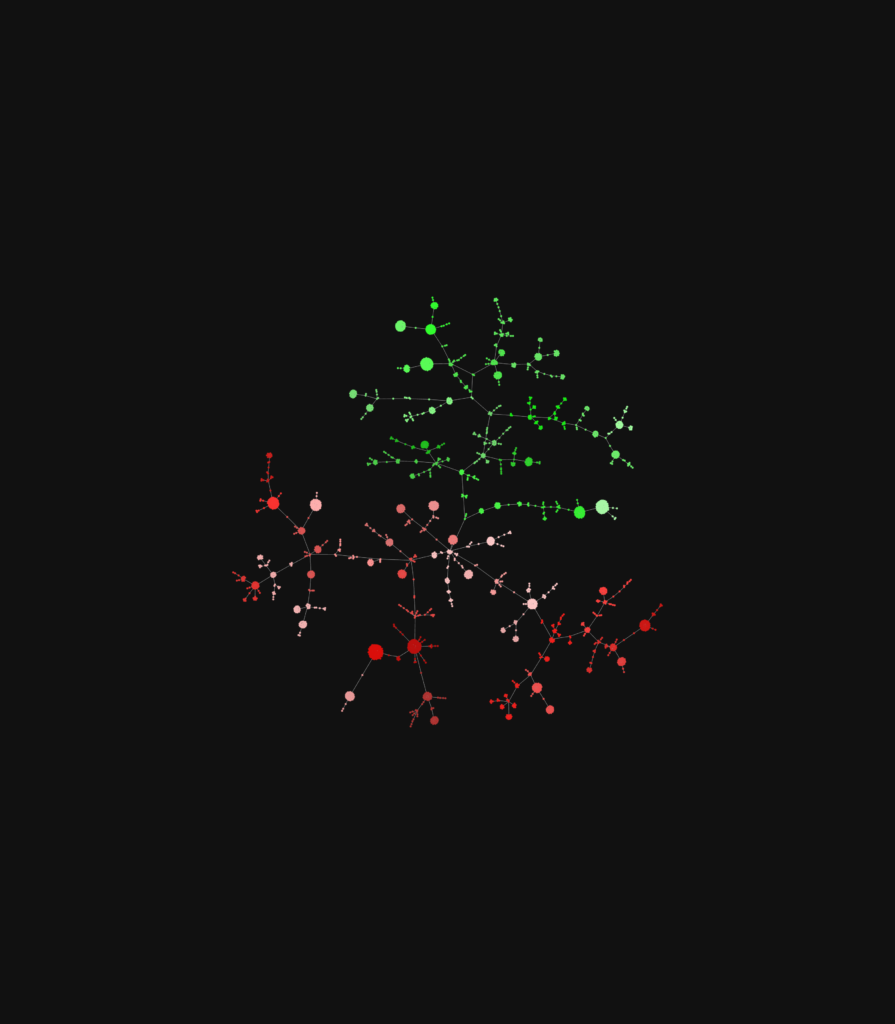
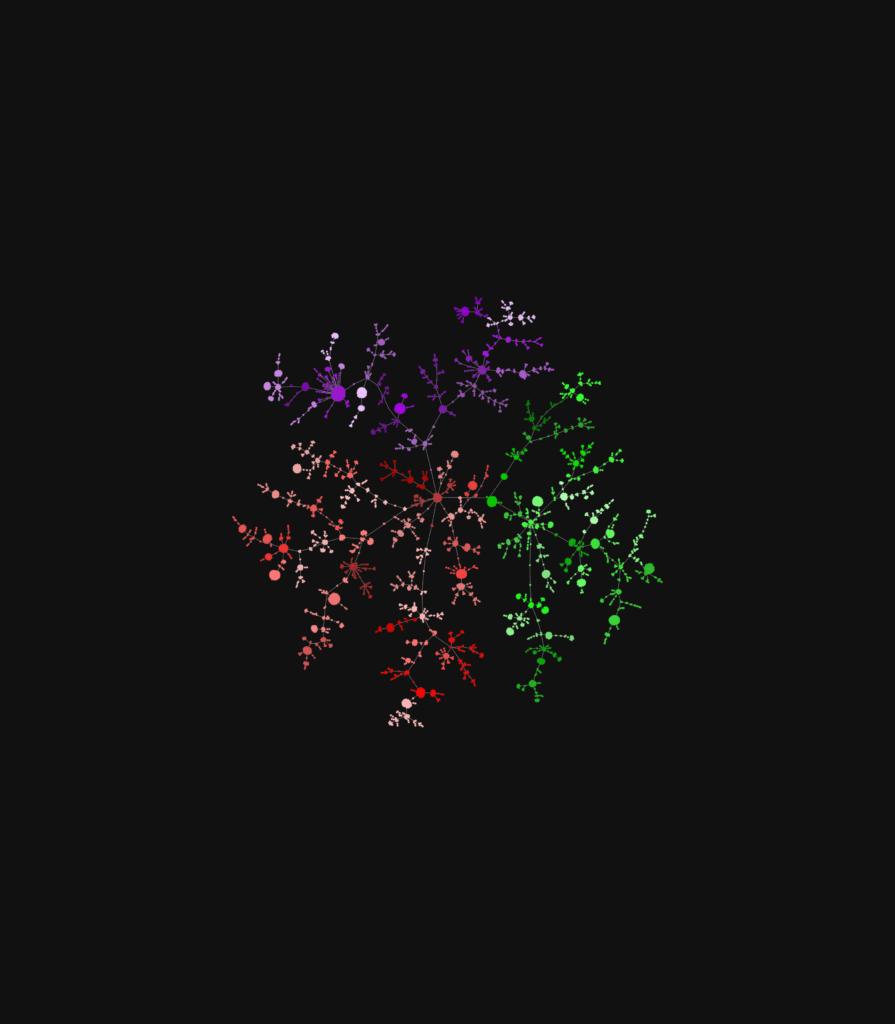
Now for the most fun part, the visual inspection: A neat trick when dealing with confusing networks is to lay out their minimum spanning tree, instead of a usually zealously pruned version of the network itself. I am using the wonderful tmap-library by Probst and Reymond (2019), and will also use faerun, a visualization framework developed by the same authors. I used the Leiden-algorithm (Traag, Waltman, and van Eck (2019)) to identify communities in the networks, which are represented by the colours below.

In the networks below we see the results. Because it would be annoying to browse through 23 graphics, I will only show each of the three decades, in the same way Petrovich and Buonomo do. To read the graphics, remember that the minimum spanning tree-construction will try to put the sources with the strongest connections next to each other, which is why we have these little balls, usually around a primary source of major importance, with which all the others are co-cited. But the algorithm sometimes has to do trade-offs, so we can not expect every node to be linked to its respective nearest neighbour.

I’ve been running the YAKE-keyword algorithm on the abstracts and titles of the citing papers associated with the communities, so we can learn a little bit more about them. Be mindful, we have only titles for the first decade, which is why keyword quality here is low.

1985-1994
[To explore an interactive version,] try it out at this link.

1995-2004
[To explore an interactive version,] try it out at this link.

2005-2014
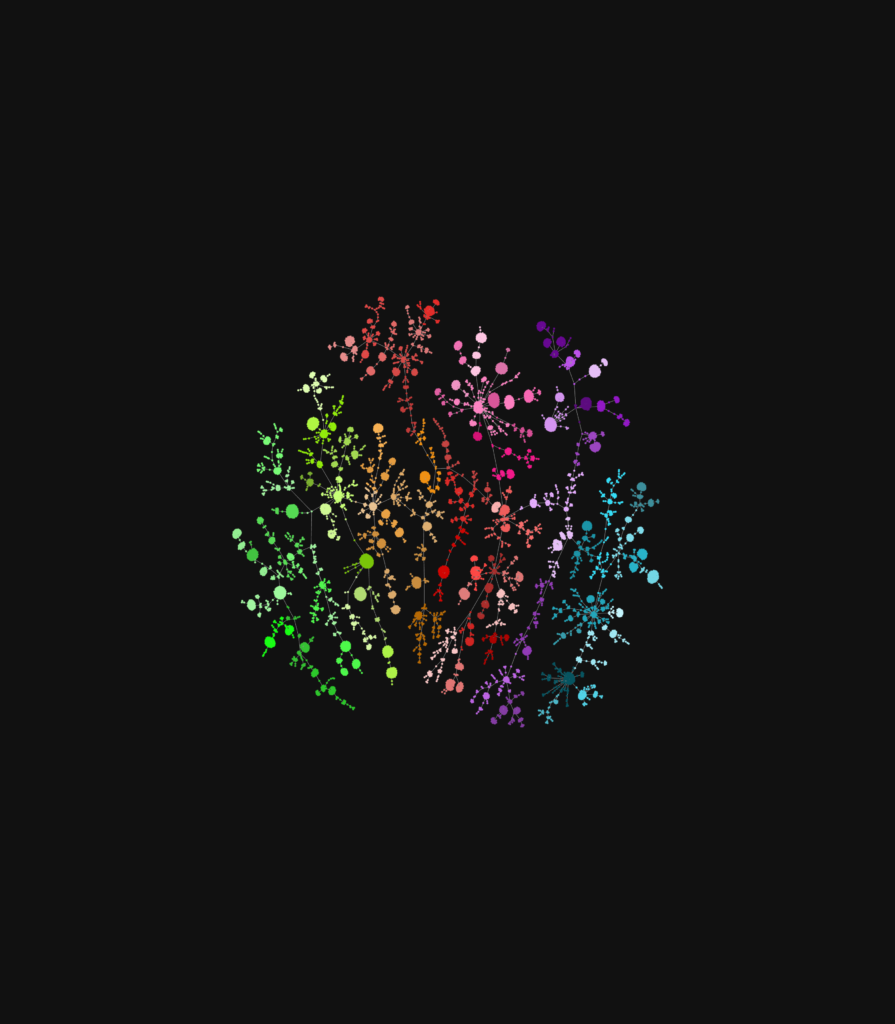
[To explore an interactive version,] try it out at this link.

I think these graphics tend to indicate that the intellectual landscape in these five journals has been broadened over time.

Length of Bibliographies

Eugenio noted that while the sample is nearly constant over time, as the five journals output similar numbers of papers every year, the length of bibliographies, and therefore the size of the co-citation networks has increased strongly. This seems to agree with general trends in philosophy. From a larger dataset I had lying around ((used in this visualization)[https://homepage.univie.ac.at/noichlm94/full/zoom_final/index.html]) I have extracted the length of bibliographies over time, and the picture suggests quite a considerable effect (depicted using ggpointdensity{.r} by (Lukas Kremer)[https://github.com/LKremer/ggpointdensity]).
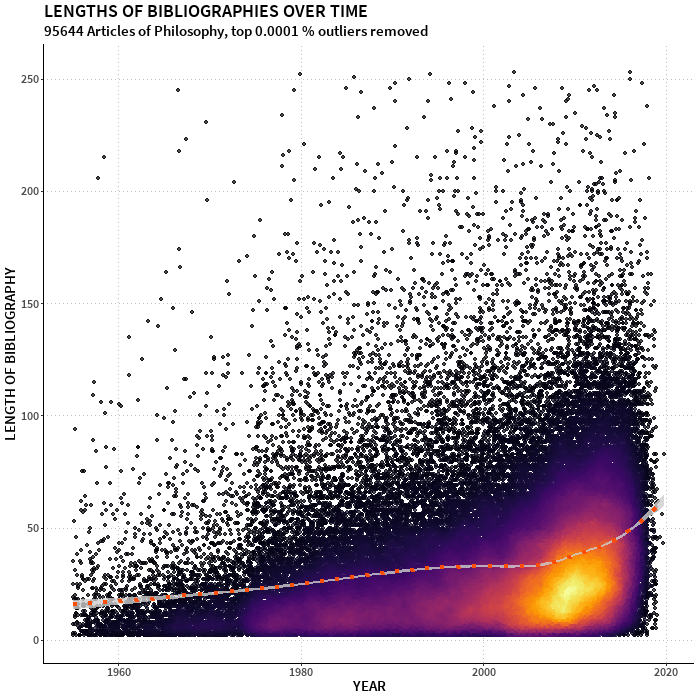
It is at the moment not clear to us what drives this effect. On the one hand, technological advancements might have made the management of large amounts of literature far easier. But it might as well be connected with various cultural changes in the discipline. I’m very interested to hear opinions on how this effect should be treated when doing diachronic analyses of literature: Should it somehow be corrected for, to ease comparability? How can it be treated a genuine feature of the data?

Literature

Petrovich, Eugenio, and Valerio Buonomo. 2018. “Reconstructing Late Analytic Philosophy. A Quantitative Approach.” Philosophical Inquiries 6 (1): 151–82. https://doi.org/10.4454/philinq.v6i1.184.

Probst, Daniel, and Jean-Louis Reymond. 2019. “Visualization of Very Large High-dimensional Data Sets as Minimum Spanning Trees”. ChemRxiv. https://doi:10.26434/chemrxiv.9698861.v1.

Tang, Muh-Chyun, Yun Jen Cheng, and Kuang Hua Chen. 2017. “A Longitudinal Study of Intellectual Cohesion in Digital Humanities Using Bibliometric Analyses.” Scientometrics 113 (2): 985–1008. https://doi.org/10.1007/s11192-017-2496-6.

Traag, V. A., L. Waltman, and N. J. van Eck. 2019. “From Louvain to Leiden: Guaranteeing Well-Connected Communities.” Scientific Reports 9 (1): 5233. https://doi.org/10.1038/s41598-019-41695-z.
Posted in Data-Driven Research, History of philosophy | 1 Comment

Franco Moretti: a lecture in Turin (20 November)

We are pleased to announce that, following an invitation from DR2, Franco Moretti will deliver a talk in Turin on November 20, h17-19, in via Sant’Ottavio 20, Palazzo Nuovo, room 10 (1st floor). The language will be Italian.
For more information, ask paolo.tripodi@unito.it.


Bivio. Lo studio della letteratura tra ermeneutica e quantificazione.

Abstract: Che rapporto esiste, tra la storia quantitativa della letteratura che ha preso forma negli ultimi vent’anni, e la precedente tradizione ermeneutico-interpetativa? In genere, le risposte a questa domanda sono state di due tipi: da parte interpretativa, l’idea è che i due approcci siano incompatibili fra loro, e che le ricerche quantitative siano prive di valore critico; da parte di queste ultime, i due metodi vengono invece visti come entrambi validi, e anzi complementari. Lavorare a questo saggio mi ha convinto di una terza possibilità, che emergerà via via dal confronto tra il modo di lavorare delle due strategie di ricerca. Il modo di lavorare, alla lettera: nella convinzione “che la pratica – cio’ che impariamo a fare ‘facendolo’, sviluppando pian piano un’abitudine professionale che troviamo perfettamente ‘naturale’ – abbia delle fortissime implicazioni teoriche; che a volte contraddicono persino le dichiarazioni teoriche esplicite.” In quell’articolo, “pratica” stava a indicare il tipo di visualizzazione tipica delle digital humanities; qui, indica invece la catena di scelte concrete che caratterizza due diversi strategie di ricerca. Ma lo scopo è lo stesso: capire quel che una metodologia fa effettivamente fare, e non quel che dichiara di voler fare.

Posted in Franco Moretti | Comments Off on Franco Moretti: a lecture in Turin (20 November)

Project REPOSUM: public presentation of results

We are pleased to announce that on November 15th, 2019 (1o am), a public presentation of the results of the project REPOSUM, funded by Fondazione CRT, will take place at the Conference Room of Rinascimenti Sociali, via Maria Vittoria 38, Turin (maps).

Everybody is welcome!

Posted in Uncategorized | Comments Off on Project REPOSUM: public presentation of results

A quantitative history of “Philosophy of Science”

Three reseachers from the University of Québec, Montréal – Christophe Malaterre, Jean-François Chartier, and Davide Pulizzotto (the latter also being an affiliate member of DR2 group) have recently published an intriguing paper entitled What Is This Thing Called Philosophy of Science? A Computational Topic-Modeling Perspective, 1934–2015. (See the abstract below).
In that paper, currently available as an online-first on HOPOS: The Journal of the International Society of the History of Philosophy of Science, they apply unsupervised text-mining methods to the complete corpus of the journal Philosophy of Science. They thus mapped the evolution of 126 topics over the 82 years of activity, and provided (seminal) interpretation of some of the many interesting patterns resulting from their analysis.

Some of the findings were also summarised by the portal Daily Nous on August 28th, 2019.

Got any comments? Let us know by commenting this post!


Abstract: What is philosophy of science? Numerous manuals, anthologies, and essays provide carefully reconstructed vantage points on the discipline that have been gained through expert and piecemeal historical analyses. In this article, we address the question from a complementary perspective: we target the content of one major journal in the field—Philosophy of Science—and apply unsupervised text-mining methods to its complete corpus, from its start in 1934 until 2015. By running topic-modeling algorithms over the full-text corpus, we identified 126 key research topics that span 82 years. We also tracked those topics’ evolution and fluctuating significance over time in the journal articles. Our results concur with and document known and lesser-known episodes in the philosophy of science, including the rise and fall of logic and language-related topics, the relative stability of a metaphysical and ontological questioning (space and time, causation, natural kinds, realism), the significance of epistemological issues about the nature of scientific knowledge, and the rise of a recent philosophy of biology and other
trends. These analyses exemplify how computational text-mining methods can be used to provide an empirical large-scale and data-driven perspective on the history of philosophy of science that is complementary to other current historical approaches.

Posted in Data-Driven Research, DR2, History of philosophy, Text-Mining | Comments Off on A quantitative history of “Philosophy of Science”

New DR2 paper is out on BJHP

Dear all,

we are glad to announce that the paper Academic success in America: analytic philosophy and the decline of Wittgenstein, written by DR2 co-founders Guido Bonino and Paolo Tripodi, has been recently published (as on online-first) on The British Journal for the History of Philosophy.

Abstract: There is a rather widespread consensus, among historians of philosophy, concerning the decline of Wittgenstein amid recent analytic philosophy. However, the exact import of such a decline, its chronological development, as well as its causes and several other features, are difficult to ascertain with the traditional methods of the history of philosophy. In this article we applied a distant reading approach, and a variety of other quantitative methods, trying to provide a more reliable and accurate account of Wittgenstein’s decline. We focused on a corpus consisting of the metadata of US PhD dissertations in philosophy from 1981 to 2010 (although other kinds of data are also taken into consideration), and we tried to relate the topic of the dissertation to the success of the candidate in his/her subsequent academic career. The results of this analysis, corroborated by other evidence, allowed us to put forth the more reliable and accurate account just hinted at, and at the same time to suggest – as a contribution to external history of philosophy – a plausible mechanism at the basis of the decline itself, notably a process driven by those who controlled the recruitment policies in the philosophy departments.

Posted in Uncategorized | Comments Off on New DR2 paper is out on BJHP

DR2@STOREP2019 (or: history of philosophy meets history of economic thought)

As mentioned in a previous post, on Saturday 29 June, some members of  DR2 were at the conference of the Italian Society for the History of Political Economics (STOREP2019) in Siena. Indeed, DR2 was co-organizing a session entitled Maps of science: new problems, new tools, new opportunities, whose speakers and discussants were members (core or affiliate) of our group:

  • Baccini, Barabesi, Gingras & Kelfaoui Intellectual and social similarity among scholarly journals. An exploratory comparison of the networks of editors, authors and co-citations
  • Petrovich – The structure of scientific disciplines. Some notes on the
    epistemology of algorithmic representations of disciplines
  • Ambrosino, Cedrini, Davis, Fiori, Guerzoni & Nuccio  The problem of knowledge classification in economics: The potentialities of automated information retrieval systems

DISCUSSANTS: Bonino, Tripodi

For those interested, below is the manuscript of Petrovich’s talk The structure of scientific disciplines. Some notes on the epistemology of algorithmic representations of disciplines: PETROVICH@STOREP2019

Posted in Uncategorized | Comments Off on DR2@STOREP2019 (or: history of philosophy meets history of economic thought)

The fabric of Knowledge

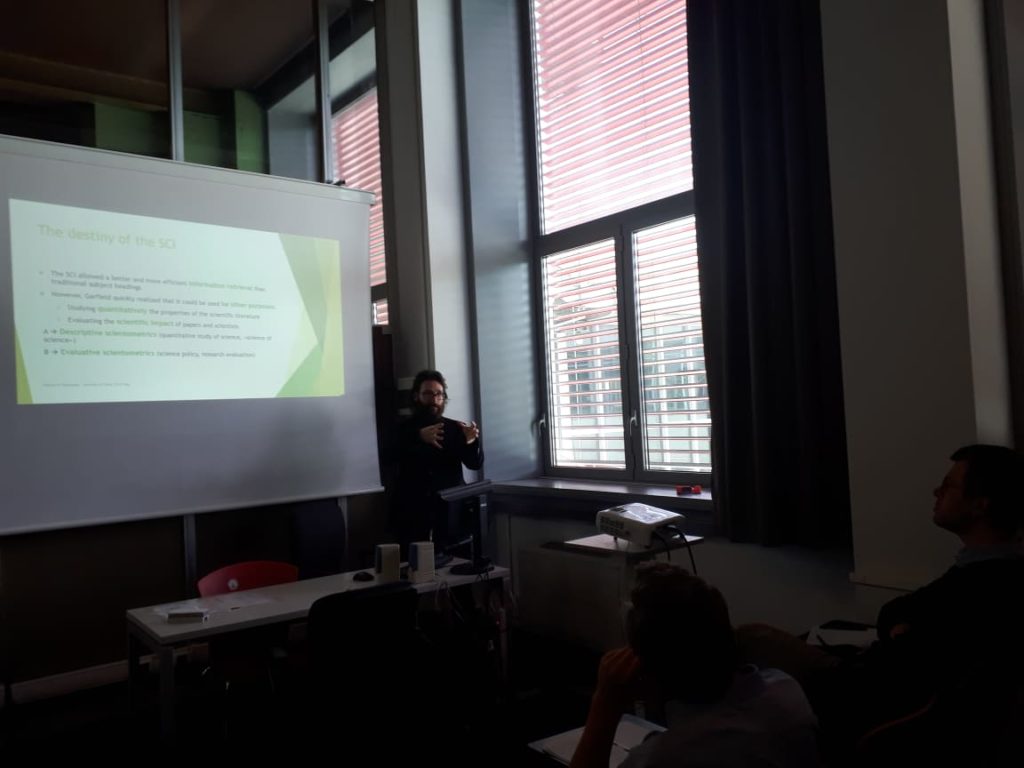
During Paolo Tripodi’s History of Philosophy II course (part of the Philosophy International Curriculum at the University of Turin), on May 21-22, 2019, Eugenio Petrovich (University of Siena) delivered two invited lectures, which he entitled “The Fabric of Knowledge. Investigating contemporary philosophy by the methods of scientometrics”.

Here are the slides of his lectures.

Posted in Data-Driven Research | Comments Off on The fabric of Knowledge

Open Peer Review, round 4

A new paper is now available for Oper Peer Review in our companion blog: Reading Wittgenstein Between the Texts, authored by Marco Santoro (University of Bologna), Massimo Airoldi (University of EM Lyon) and Emanuela Riviera (Independent Scholar).

POST — HOW TO COMMENT

Sharing the “historicist challenge to analytic philosophy” (Glock 2006) we attempt a “distant reading” of the (mainly) philosophical literature on and about Ludwig Wittgenstein. We start with a descriptive profile of the temporal structure of LW’s work. Then we focus on the literature (i.e. scholarship) on LW as we have been able to represent it through an analysis of bibliographic data drawn from the Philosopher’s Index, an electronic bibliographic database especially devoted to philosophy as a discipline. This is the central section of our paper, and the longer one, in which we attempt to describe and to map with the help of more sophisticated statistical tools Wittgenstein scholarship in its properties and changing forms. We look at the social profile and relations of the authors who contributes to the establishment of LW as a central reference in the current intellectual landscape as well as the network and dynamics of topics to which LW has been associated.  We end by proposing a set of possible explanatory frameworks (not really explanations, but research directions for elaborating explanations) for our results. With our paper we would add a “social dimension” to the aforementioned historicist challenge, making a case for an historical-sociological approach to (analytic) philosophy, along the lines of Bourdieu (1988) on Heidegger, Lamont (1992) on Derrida, Gross (2006) on Rorty, and Collins (1999) on the whole philosophical tradition.

[… continue at this link]

Posted in Uncategorized | Comments Off on Open Peer Review, round 4

DR2 teachings: invited speakers at Paolo Tripodi’s History of Philosophy II course

In the academic year 2018-2019 the History of Philosophy II course (Philosophy International Curriculum, University of Turin, prof. Paolo Tripodi) is devoted to distant reading and data-driven research in the history of philosophy.

The course will host five special talks and a lab:

  • 20 May: P. Babbiotti, G. Matteoli, N. Ruschena, V. Vadori (University of Turin), Competition in the Harvard Business Review (Part 1)
  • 21 May: E. Petrovich (University of Siena), The Fabric of Knowledge. Investigating Contemporary Philosophy by the Methods of Scientometrics (Part 1)
  • 22 May: E. Petrovich (University of Siena), The Fabric of Knowledge. Investigating Contemporary Philosophy by the Methods of Scientometrics (Part 2)
  • 27 May: M. Cedrini (University of Turin), Distant Reading in the History of Economic Thought
  • 28 May: P. Babbiotti, G. Matteoli, N. Ruschena, V. Vadori (University of Turin), Competition in the Harvard Business Review (Part 2)
  • 29 May: Students lab: using Python with the aid of G. Carducci (Synapta)
  • 3 June: Students lab: using Python with the aid of G. Carducci (Synapta)
Posted in Uncategorized | Comments Off on DR2 teachings: invited speakers at Paolo Tripodi’s History of Philosophy II course

Open bibliography of quantitative studies of philosophy

We are pleased to publish the first version of the DR2 open bibliography for quantitve studies in philosophy, which inagurates a new section of our site, TOOLS.

This first version is based on a work by Eugenio Petrovich. However, we plan to release future versions, (also) based on users’ comments. Any suggestion is thus warmly welcome!

Posted in Uncategorized | Comments Off on Open bibliography of quantitative studies of philosophy