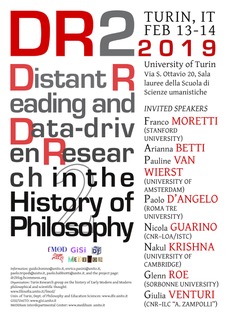
Franco Moretti’s slides at DR2 conference

We are pleased to share the slides of Franco Moretti‘s talk (in italian) La visualizzazione dei dati nella storia culturale: riflessioni autocritiche, held at Turin on 13th February during the Second DR2 Conference. Below you can also find the recordings of his talk (in italian).

Moretti, Slides DR2 Conference 2019

Moretti, Video DR2 Conference 2019

* * *

Besides, Davide Pulizzotto and Valerio Buonomo have joined the centre as affiliate members (check out their profiles in the People section of this blog). Let us warmly welcome them!

Posted in Uncategorized | Comments Off on Franco Moretti’s slides at DR2 conference

DR2 @STOREP 2019

We are pleased to announce that several members of the DR2 research group have proposed a joint session with STOREP (Associazione Italiana per la Storia dell’Economia Politica / Italian Society for the History of Political Economics) during the upcoming 16th STOREP conference, to be held in Siena on June 25-27th. Continue reading

Posted in Data-Driven Research, Distant Reading, DR2 | Comments Off on DR2 @STOREP 2019

Open Peer Review, round 3

A new paper is now open for Oper Peer Review in our companion blog: Two Quantitative Researches in the History of Philosophy. Some uphazard methodological reflections, authored by Guido Bonino (Turin), Paolo Maffezioli (Barcelona), and Paolo Tripodi (Turin).

POSTHOW TO COMMENT

In this paper we are going to put forth some methodological reflections on two different investigations we have conducted in the context of the DR2 research group. Such investigations were our first serious attempts at applying distant reading techniques and more in general quantitative methods to the history of philosophy. A sketchy preliminary presentation of the two researches is in order as a basis for the methodological remarks.

[… continue at this link]

Posted in Uncategorized | Comments Off on Open Peer Review, round 3

Welcome to our affiliate members!

The PEOPLE section of this blog has been updated, so as to include the profiles of our first wave of affiliate members, i.e. those scholars with whom we have and/or we will have fertile scientific exchanges.

We are proud of our collaborations and we wish all of them a wam welcome!

Posted in Uncategorized | Comments Off on Welcome to our affiliate members!

DR2 Conference – video and greetings

The Second DR2 Conference was held at the University of Turin on February 13-14. We would like to thank all the speakers and the participants for the interesting and intense debate.

* * *

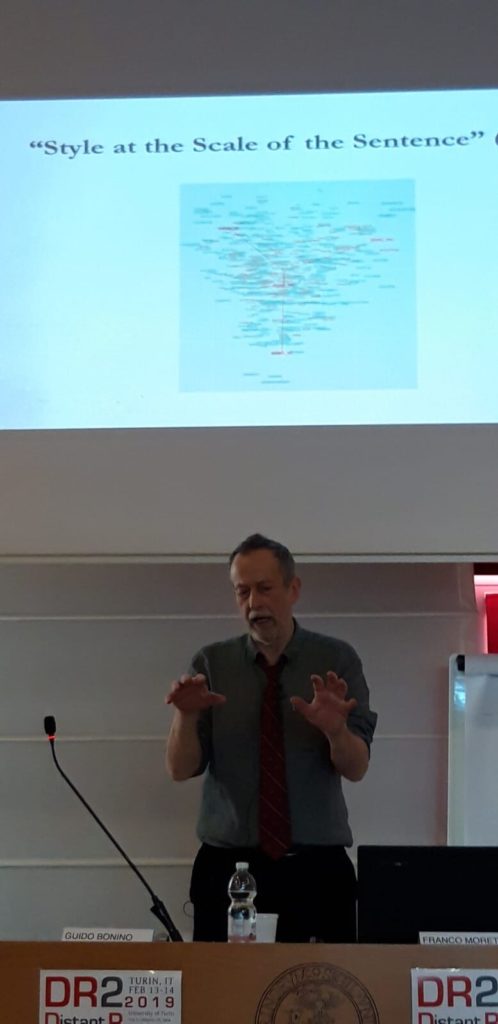
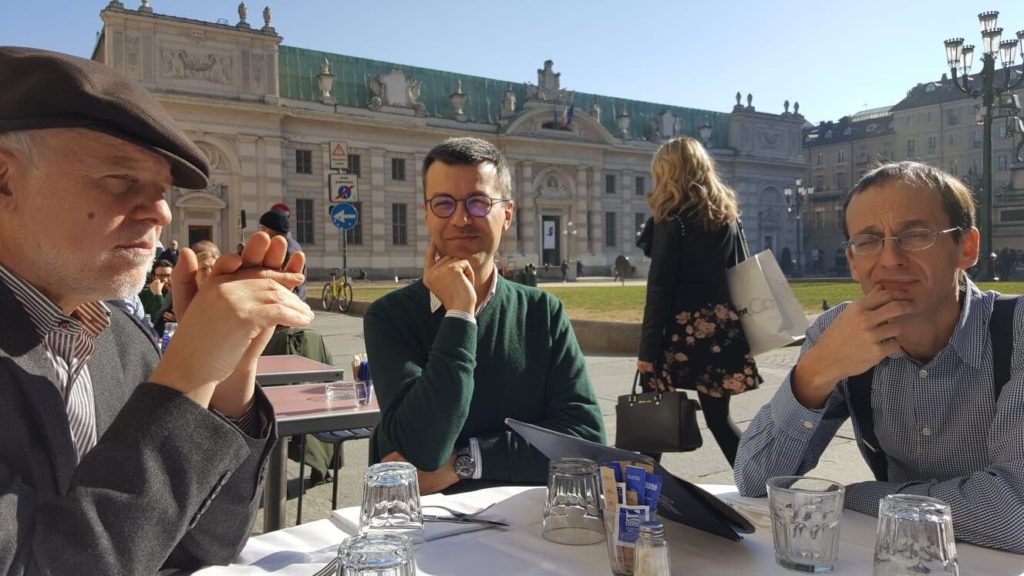
The conference was opened by Franco Moretti’s self-critical reflections on data visualisation in cultural history. To see and listen to the video of Moretti’s opening lecture (in Italian, with the title “La visualizzazione dei dati nella storia culturale: riflessioni autocritiche”), please click on the picture below.
The conference was divided into two main sessions. The first session was devoted to the issue of style in philosophy. As Guido Bonino and Paolo Tripodi (University of Turin) stated in the introductory remarks, the aim of the session was that of understanding how to investigate philosophical style from a historical point of view by employing distant reading techniques and quantitive methods.

A preliminary task, that of clarifying the very concept of philosophical style, was tackled by Nakul Krishna (University of Cambridge).
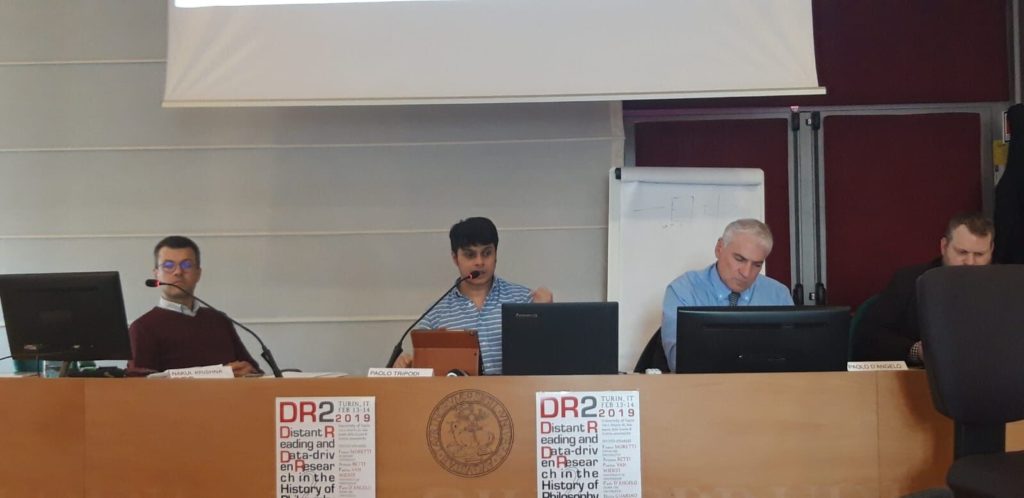
Glenn Roe (University of Paris, Sorbonne) presented a survey on stylometric studies in the digital humanities, focusing on Voltaire as an example.

Paolo D’Angelo  (University of Rome III) closed the first session by reflecting upon the the relationship between style and literary genre in philosophy.

* * *

The second session was devoted to the issue of corpora building.

 In his talk Enrico Pasini (University of Turin) offered some remarks on the methodological and epistemological challenges posed by corpus-based research in the history of ideas.

Starting from the consideration of several case-studies taken from Arianna Betti’s research group in Amsterdam, Arianna Betti and Pauline van Wierst (University of Amsterdam) reflected on the practical and methodological difficulties one may encounter in building corpora, with a special focus on the problems of the objectivity and quality of corpora.

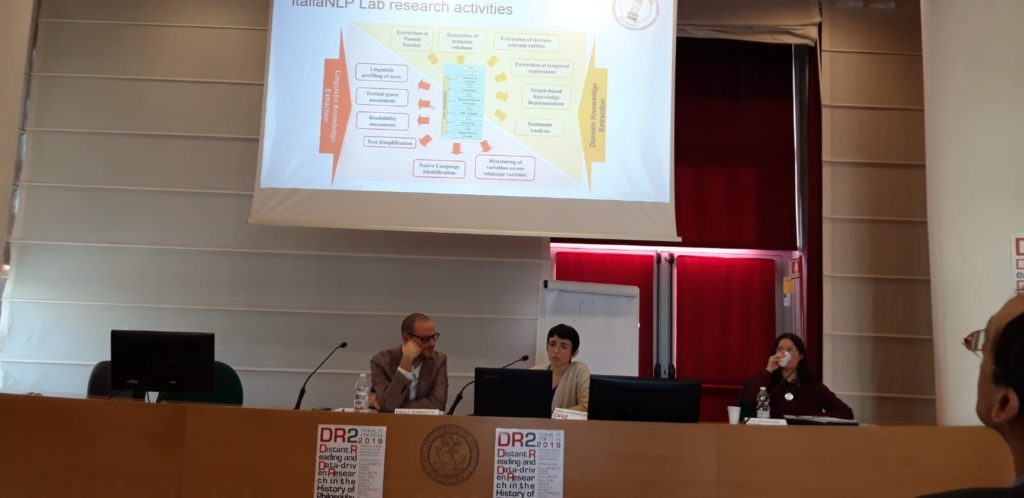
The second session was closed by Giulia Venturi (CNR, Pisa), who brought to the conference the point of view of computational linguistics by giving a talk on Natural Language Processing methods and instruments for the extraction of information from domain corpora.

The debate was very fruitful, also thanks to the session discussant, Julie Giovacchini (CNRS Paris).
The concluding lecture, given by Nicola Guarino (CNR, Trento) and introduced by Daniele Radicioni (University of Turin), was based on the idea that applied ontology could provide distant reading and data-driven research in the history of ideas with several useful semantic tools.

* * *

It seems to us that this second DR2 Conference has confirmed that a lively, multidisciplinary and collaborative community is growing up, which includes not only researchers but also students, and this is a good sign for our future work.

Posted in DR2, Franco Moretti, Turin Conference | Comments Off on DR2 Conference – video and greetings

A new paper for the Open Peer Review project

A new paper is open for comments for the Open Peer Review projectExploring knowledge dynamics in the humanities. A science-mapping approach to the history of contemporary analytic philosophy and human geography, by Eugenio Petrovich (University of Siena) and Emiliano Tolusso (University of Milan).

POSTHOW TO COMMENT

In this post, we discuss some of the results we presented at the conference “Distant Reading & Data-Driven Research in the History of Philosophy” (University of Turin, 16-18 January 2017). Our talk aimed to explore the dynamics of knowledge in the humanities with a quantitative approach drawn from scientometrics (the field studying the quantitative aspects of the scientific production). In particular, we wanted to assess the viability of citation network visualization techniques (known as “science mapping”) as a tool for reconstructing the recent history of two fields in the humanities: analytic philosophy and human geography.

[… continues at this link]

Posted in Uncategorized | Comments Off on A new paper for the Open Peer Review project

DR2 Conference – Turin, February 13-14

We are pleased to announce the upcoming second DR2 conference, to be held at the University of Turin on February 13-14.

Program

Venue:

Sala Lauree della Scuola di Scienze Umanistiche, via S. Ottavio, 20 (Google Maps)

February 13

10.00
Welcome and Introduction

Franco Moretti (Stanford)

La visualizzazione dei dati nella storia culturale: riflessioni
autocritiche

15.00
First session: Style in philosophy

Guido Bonino and Paolo Tripodi (Torino)

Introduction

Nakul Krishna (Cambridge)

The Concept of Philosophical Style

Glenn Roe (Paris Sorbonne)

Voltaire’s Style: Old Ideas and New Methods

Paolo D’Angelo (Roma Tre)

The Suspicion Towards Style in Philosophy

 * * *

February 14

9.30
Second session: Corpora

Enrico Pasini (Torino)

Challenges Posed by Corpus-Based Research in the History of Ideas

Arianna Betti and Pauline van Wierst (Amsterdam)

Building Corpora: Objectivity and Quality of Corpora for Philosophical Research

Giulia Venturi (CNR, Pisa)

Natural Language Processing: Methods and Tools for data-mining from domain-specific corpora

Discussant: Julie Giovacchini (CNRS, Paris)

15.00

Daniele Radicioni (Torino): Introduction

Nicola Guarino (CNR, Trento)

Ontological Analysis and Applied Ontology


for information, please write to guido.bonino@unito.it, enrico.pasini@unito.it,
paolo.tripodi@unito.it, or paolo.babbiotti@unito.it

Download the poster in PDF

Download the flyer in PDF

Posted in Arianna Betti, DR2, Franco Moretti, Turin Conference, Uncategorized | Comments Off on DR2 Conference – Turin, February 13-14

The Open Peer Review Project has started!

Several participants to the DR2 Conference agreed to publish some short versions of the conference talks in the form of working papers. 

With the aim of maximizing the quality of the discussion and the dissemination of our works, we propose to set up a process of Open Peer Review.

The working papers will be published as separate posts at regular intervals on a twin blog, which you can easily reach starting from the main blog (see button on the right). On the twin blog, readers will be allowed to comment in the margins of the posts.

The working papers will move to this main blog after the review, and a new working paper will undergo the same process.

A final publication will collect the working papers, the results of the Open Peer Review and maybe those discussions that should deserve to be reproduced. The publication venue will be a special issue of the Journal of Interdisciplinary History of Ideas.

We are happy to announce that the first working paper – Mark Alfano (Delft University of Technology and Australian Catholic University), A semantic-network approach to the history of philosophy, or, What does  Nietzsche talk about when he talks about emotion? – has now been published at this link on the Open Peer Review blog. You are all are invited to read and comment on it.

You can find the instructions for commenting on the Oper Peer Review blog’s homepage.


Have you ever read an article that makes claims like, “Plato often talks about W” or “Kant typically associates X and Y” or “In his early work, Nietzsche seldom engages with Z”? I have. When I read these claims, I want to ask simple-minded questions like, “How often?” and, “What do you mean, ‘typically’?” and, “How seldom is seldom?” If these sorts of claims have any evidential value, it should be possible to verify or falsify them. Or — to turn the conditional around — if it’s not possible to verify or falsify them, then these sorts of claims have no evidential value.

As preparation for my in-progress book on Nietzsche’s moral psychology, I’m developing a methodology for quantifying, mapping, and analyzing the concepts used in philosophical corpora. My hope is that this methodology will make it possible to answer the simple-minded questions mentioned above, and that answering these questions systematically will lead to new insights. Furthermore, if my approach is on the right track, it should be fairly easy to retool it for the study of corpora by other philosophers, as well as corpus comparisons between (groups of) philosophers. [… continues at this link]

Posted in Uncategorized | Comments Off on The Open Peer Review Project has started!

A grant for the DR2 group

Good news for the DR2 Research Group!

We are pleased to announce that the DR2 research group has been awarded a grant by Fondazione CRT for the project REPOSUM.

The project is based on a public-private partnership and, in particular, on the collaboration between the DR2 research group (Guido Bonino, the project coordinator, Enrico Pasini and Paolo Tripodi), two computer scientists of the University of Turin (Daniele Radicioni and Alessandro Mazzei) and Synapta SRL (directed by Federico Morando).

The present project mainly deals with the history of contemporary Anglo-American philosophy. Taking into account the metadata of more than 20,000 PhD dissertations in philosophy defended in the US in the last 40 years, we have analyzed the keywords occurring in the abstracts, as well as the geographical distribution and chronology of the theses. In particular, we have focused on the relationship between the subject of the theses and the future academic success of the PhD candidates. So far this work has been carried out by applying relatively unsophisticated procedures.

The development of this work, however, requires for the future the use of (at least partly) automated procedures, which are not available yet. By collaborating with Synapta, the DR2 group aims to create such tools. Of course, the creation of the digital tools does not start from scratch, as it is possible to integrate open source solutions, developed for other applications and other domains, and use Linked Open Data protocols. The tools will also be tested on a different corpus – consisting of Italian PhD theses in philosophy – provided by the Central National Library of Rome.

Posted in Digital Humanities, Distant Reading, Fondazione CRT | Comments Off on A grant for the DR2 group

Two job openings at the ILLC

Two job openings at the ILLC (Institute of Logic, Language and Computation) University of Amsterdam, The Netherlands, in my VICI project on creating a computational history of ideas (2017-2021):
PhD student in History and Philosophy of Logic and Mathematics (Bolzano)

http://www.uva.nl/en/content/vacancies/2017/08/17-411-phd-candidate-in-history-and-philosophy-of-logic-and-mathematics.html

Postdoctoral researcher in History and Philosophy of Logic and Mathematics (Frege)

http://www.uva.nl/en/content/vacancies/2017/08/17-410-postdoctoral-researcher-in-history-and-philosophy-of-logic-and-mathematic.html?origin=dxuSI3bDRY2CW7N9J3yPlw

DEADLINE Sep 14, 2017

Great environment, great city, nice people.

Any help with spreading the ad is much appreciated!

Arianna Betti


Professor and Chair of Philosophy of Language, University of Amsterdam (ILLC) | VICI, ERC PoC & St Grantee | ex-De Jonge Akademie of the KNAW & Global Young Academy  | AcademiaNet
Posted in Arianna Betti, Call for application, Job, University of Amsterdam | Comments Off on Two job openings at the ILLC